Showing posts with label DC Comics. Show all posts

Monday, February 13, 2017

COMIC COMMENTARY, COMICS READ WEEK OF 2/6/2017


Modern Marvels
DC Comics Pick of the Week: Action Comics #973
                Superman unwittingly leaves a trail to the Fortress while Lois continues to dig into the mystery of Clark Kent.  Dan Jurgens continues to prove that he has a grasp on Superman as a character like few others.  Since the onset of Rebirth, Jurgens has put several plates into play:

  •      How will Superman react to New 52 Lex Luthor?
  •      Who is Mr. Oz?
  •      Who is Clark Kent?

The last story arc established a détente between Luthor and Superman, with both realizing that their nemesis is not the same man that they have known on both sides.  This story arc drives into the mystery of the second Clark Kent and the potential danger he poses to Superman’s private life.
Honorable Mentions (an above average read): Deadman: Dark Mansion of Forbidden Love #3, Deathstroke #12, Justice League of America Rebirth #1, New Super-Man #8, Red Hood and the Outlaws #7, Wonder Woman #16 (Yes, Rebirth is this good!!)
Other reads:  All-Star Batman #7, Batgirl and the Birds of Prey #7, Detective Comics #950, Earth 2 Society #21, Flash #16, Gotham Academy Second Semester #6, Hal Jordan and the Green Lantern Corps #14, Suicide Squad #11, Supergirl #6, Superwoman #7, and Titans #8
Marvel  Comics Pick of the Week: Ms. Marvel #15
                At first it seems like this issue has dropped the previous thread of Kamala being confronted by a member of on-line guild, and instead introduces a story of cyber-bullying and the levels at which a second-generation immigrant feels they have to over-compensate in modern America to validate their culture and break down stereotypes.  It quickly ties the two together by the online entity threatening to blackmail Kamala being the same one involved in the cyber-bullying.  Ms. Marvel continues to be a delight, an all-ages female-centric title that manages to cover topical issues without preaching.  It is one of the few female friendly titles I feel comfortable allowing my 10-year old daughter read.
Honorable Mentions (an above average read): Amazing Spider-Man: Renew Your Vows  #4
Other reads:  All-New Wolverine #17, Black Widow #11, Deadpool the Duck #3, Doctor Strange and the Sorcerers Supreme #5, Foolkiller #4, Inhumans Vs x-Men #4, Jessica Jones #5, Kingpin #1, Power Man and Iron Fist #13, Totally Awesome Hulk #16, Unbeatable Squirrel Girl #17, Uncanny Inhumans #1.MU, and Unworthy Thor #4

Silver Age Spotlight
Marvel Silver Age Pick of the Week: Fantastic Four #56
                Klaw attacks the FF to try and drive the Black Panther to him.  A great issue with a lot of tension.  Klaw appears as he would be until the Modern age with a great design by Kirby, and a fantastic power set.  Lee and Kirby draw tension by having the Fantastic Four separated: Johnny is out looking for Crystal, Reed and Ban are in the lab, and Sue is cleaning up the apartment.  This allows Klaw to ratchet up the menace by taking on Sue and Ben one-on-one.  The only gap in plot is the fact that Klaw attacks at all.  There really isn’t a reason for him to be here, other than this is the FF’s comic.  Klaw knows who T’challa is and where Wakanda is, so using the FF as a go between doesn’t work.  However, the climax kind of uses that conceit to its advantage, as T’Challa sends Reed a needed component to help Reed, as Klaw intended, but the macguffin is delivered via a remote controlled automaton and not in person, thwarting his revenge.  We also get a rare sight, Reed beating a foe hand-to-hand, using the Vibranium bands delivered by the Black Panther to pummel Klaw into submission.
Honorable Mentions: Daredevil #21
Other Reads: Amazing Spider-Man #42, Amazing Spider-Man Annual #3, Avengers 33, and Fantastic Four Annual #4

DC Silver Age Pick of the Week: Funny Stuff #35
                I don’t have much to say, but Funny Stuff is probably my second favorite humor title of this area.  Blackie Bear and J. Rufus Lion are strong features, but the stars are Dodo and the Frog, and their strips whether a multi-page story or a strip ad-page topper are a delight.
Honorable Mentions: Adventure Comics #130 (Superboy feature only), Star Spangled Comics #82 (Tomahawk feature only)
Other Reads: Animal Antics #15, Western Comics #4


Golden Age Greats
I didn’t make much progress with my DC Golden Age Reading List.  Green Lantern #6 was a chore to get through.  It surprises me a lot, but this is the Golden Age title I struggle with the most.  The character as he is used isn’t compelling enough to sustain a 60+ page story and the direction is wrong-headed.  Enlisting Alan in the army, severely limits the stories you can do with him, and while I know continuity wasn’t a concern in the 40’s, it puts the quarterly book at odds with the monthly feature in All-American where Alan is still a civilian radio engineer.

Tuesday, September 13, 2016

Superman #6, Detective Comics #^^ (First Two-Face) and a mini-review of Inception

COMIC COMMENTARY


Modern Marvels
Superman #6: I've really enjoyed the "rebirth. Revamp" of recent DC books.  It feels like we are in a new renaissance of DC comics.  No where has this been more evident than in the Superman books.  This month's issue wrapped up the Eradicator storyline, sets up a new Superboy that is in its own way unique, and gives us the book's focus on Superman and his son.  Everything that was missing for the past 4 years that shows that this take is doing it right can be summed up in a single image:


Golden Age Greats
Detective Comics #66: When you list the upper-echelon of Batman's villains, Two-Face is always in the top 5.  So it was a pleasant surprise to get to his first appearance.  Almost everything we would think of as classic Two-Face is here: scarred face/scarred coin, basing crimes on "twos', you an even read the animosity between him and Robin here by applying a modern reader's sensibilities since Robin thwarts most of his attempts on Batman's life.  The solution of plastic surgery is mentioned, then discarded, as the only surgeon skilled enough is out of country due to the war.  The only notable differences are that his last name here is Kent, not Dent.  This was also notable for being a continuing story.  Early strips were modeled after newspaper strips, but other than a villain appearing to die or escape in one issue and come back in the next, this is the first time I think there has been a definitive "To be continued".  Also of note is a Boy Commando tale where a reporter from the far future has a mummy relate a wartime tale of a conflict between Nazis and the Boy Commandos in Egypt.  Yeah, I'll repeat that: a mummy tales a reporter in a space age future about a battle in WWII.


MOVIE MADNESS

Inception: I just watched Inception for the first time.  I found it to be really interesting and visually really creative.  I enjoyed it on its surface, but I think those trying to find multiple layers and readings on the film to parallel the multiple layers of dream presented in the film are trying to hard, and while many reviewers at the time tried to present it as an extremely complex narrative, I think on the whole it was relatively simple (but then multiple earths, timelines, etc. are my bread and butter so what do I know).  My really only complaint with this film was Marion Cotilliard.  I don't know if I've seen her in anything else, but she really grates on the nerves here as Mal.


Friday, September 9, 2016

Black Dragons, Black Panthers, and Podcasts

This one is an amalgamation of the past few days due to birthday celebrations and all-day work conferences.

COMIC COMMENTARY

Golden Age Greats 


All-Star Comics #12  The JSA, recently renamed the Justice Battalion splits up to save varying inventors and their inventors from the Black Dragon Society and are brought back together in the end to save Johnny Thunder and round up the leaders.  This is the same Black Dragon Society that was name-checked in the recent Atom strip in All-American on-sale the same month.  I noticed that the Sandman strip was not by Kirby and Simon which is unusual for the normal art team to not do their character's All-Star installment.


Silver Age Spotlight

Fantastic Four #52  Reed and team are lured to Wakanda to by King T'Challa in order to prove his readiness for something.  Lee and Kirby have been on a role since the beginning of the Frightful Four trilogy round #36.  This is the first one that wasn't bad, but hasn't lived up to its recent peers, especially the stellar #51.  I think what lets it down for me is Lee's dialogue.  The Panther is mister smug pants, "Ha, Ha I'm so smart and better because you can't defeat me because I laid traps."  Its bit like Kraven and Spider-Man.  Let me prove I am your better by ensuring a less than even playing field.  The story also ends abruptly for T'Challa to tell why he really wants them here in a forced cliff-hanger.  I really like that Black Panther has the classic full face mask here and not the Avengers half-mask.  I thought it was a more recent design aesthetic, but I should have trusted Kirby's design sense to have come up with it first.

PODCAST PROPS

Give Me Those Star Trek #1 The Cage click here to download Siskoid and Gene Hendricks examine the Star Trek Pilot, The Cage and muse what it might have been like if that was the Pilot that went to series.  A strong debut for the podcast.  My personal opinion is that it would have been a lot more serious Voyage to the Bottom of the Sea type of show and lasted 2-3 series.  I just don't think the type of cast would have allowed for the type of stories that made Star Trek a classic.

Film and Water Podcast: High Fidelity click here to download The episode makes me want to watch this movie.  I think I saw the latter half one night on cable when I woke up in the middle of the night one night.  It was also intersting to hear Rob have a guest on who had the same appreciation for the film, but who had different interpretations and take aways from different scenes

Palace of Glittering Delights: Enterprise  click here to download Andrew Leyland covers a recent watch-thru of key Enterprise episodes in honor of the 50the anniversary of Star Trek.  I've never seen Enterprise and this makes me want to check it out.  I think it would be interesting to watch it as kind of a Trek continuity order (ie watch Enterprise, then Star Trek TOS, then Star Trek Animated. etc.).  I do agree with Andy about the unsuitability for older shows to be binge watched, and I've started mixing and matching nights of TV from old series for fun and variety.

Also, I've listened to Jay and Miles X-Plain the X-Men episodes 103-105.  I may discuss them in more detail later, but I wanted to focus on some shows that haven't received as much coverage from me.

Monday, September 5, 2016

In Which I Lament the Lack of Editor's Notes and Say Goodbye to the Waco Kid

COMIC COMMENTARY
 Modern Material
 All-New Wolverine Annual #1:  One of the few replacement/generational characters from Marvel that I felt added, rather than subtracted from the Marvel Universe, Laura, the "All-New" Wolverine from the title, is joined by the worst, Spider-Gwen, and the issue is poorer for it.  A cross-dimensional caper, because Spider-Gwen has to brought into the 616 every chance they get (its a rule, doncha know) that doesn't make sense.  I mean I understood the plot, it just seemed a pointless run around.  There are also examples of good and bad editorial material in here.  At the recap/premise page, it explictly points out the this annual takes place before Civil War II.  Who cares?  Nothing happens of note inthis issue, and nothing of note is happening in Civil War II that affects these two characters.  The villain of the piece is enacting a revenge plot because they are related to someone the "original"Wolverine killed.  When?  Why?  Here would have been the time to include a good, old-fashioned Editor's Note.  You know, "See Super Spandex-Guy #12 --Editor".  I don't understand why today, at a time when digitally and in trades the back catalog is more available than it has ever been that this isn't used more.  One of the best digital features that never came to be was when an early digital platform (now defunct) talked about turning all those old editor notes into links that navigated your collection or prompted an impulse buy.
Amazing Spider-Man #17:  Spider-Man continues to investigate NuLife and an ally gets in trouble.  Once again trying to avoid spoilers.  A good issue.  Its another one that could have also benefited from some Editor Notes or stronger editing.  I *think* the events of this issue overlap with issue #16, but the transitions aren't very clear.  I like where this appears to be heading, but I have to ask, with the particular people involved to date, as the evil cabal grows, how likely are a majority of Spider-Man's villains likely to find out his secret identity?
Astonishing Ant-Man #11:  Not necessarily filler, but an epilogue to the last arc that sets up the next as Scott finishes his narration relating how he ended up back in prison (I presume that's not a spoiler since it was part of the narrative framework from the first issue).  This is only a Civil War II tie-in because it gets mentioned in an off-hand manner in a conversation.

Golden Age Greats
All-American Comics #41:  Not a bad issue, but nothing particularly stands-out.  The Golden Age Green Lantern helps an indian tribe realize they are being duped in a story that would be offensive today.  There is a funny bit where Doiby realizing the Indians don't really know what Green Lantern looks like, stalls for time and bluffs wearing a version of Green Lantern's costume.  Hop Harrigan gets hazed by his commanding officer (yeah, I didn't know that kind of thing was allowed in the military).  Sargon the Sorcerer prevents an assassination attempt with shaving razors and shears.  Sargon is probably the most inventive strip in the series at this point, with his power to command whatever he's touched, he uses inanimate objects in visually interesting ways, but they aren't portrayed an anthropomorphic cartoon creations like they are in the Zatara strip in Action.  In the Atom strip he stops some saboteurs from blowing up a plant.  They work for the Black Dragon Society which will feature again in All-Star and be used to good effect by Roy Thomas in All-Star Squadron.

Silver Age Spotlight
Daredevil #17: Spidey and Daredevil continue to antagonize each other before teaming-up to prevent the Masked Marauder from stealing the fuel-plans for an experimental engine.  What I liked this issue: Spidey assuming that Foggy was Daredevil, Daredevil bating and using Jonah to his own ends, the reaction of General Motors to Jonah's new special, and the solid that Daredevil does Spider-Man.  This is the start of the Spider-Man/Daredevil friendship.  When everyone jumps to the conclusion that Spider-Man is up to know good, Daredevil takes the time to correct everyone and give Spider-Man credit for the bust.  The first meeting between Spider-Man and Daredevil is referenced several times (in Amazing Spider-Man #16...cause you know, editor's notes).  The Romita art sings.  This title has sparkled since he took over, and you can tell this is a Spider-Man try-out as Spider-Man, Jonah, and May all make appearances.  It fills like Stan wanted to see how Romita would do with different key members of Spider-Man's cast.  The only negative was the over-wrought dialog about the Foggy, Karen, Matt love triangle.  It was like someone hit the slow-motion button on the book, every time it was focused on.

MOVIE MADNESS
Blazing Saddles:  We lost one of the greats last week, which prompted my wife to put on Blazing Saddles since he had never seen it.  The film is a wonderful satire of the Western genre and on race, but it is extremely shocking when watched through the cultural sensitivity lens of 2016.  This was covered wonderfully on the Film and Water Podcast click here to download.  I'll just mention some of my favorite parts:
  • There must be legal precedent....Here it is Hanley vs. United States, Hanley 7, United States nothing!
  • Sorry sir, I'm all booked until Monday.
  • Well if you must pry.  I must, I must
  • The b!t@h was creating the candygram!  And I bet they won't give me credit for them either.
  • All of the fourth wall breaking.  Everyone points out the cinema and backlot scene, but Bart talks to the camera throughout the film.

Friday, September 2, 2016

....And We're Back Again....Again

     Whew, where has the time gone?  I've taken an unplanned break.  I'll get more into the why's wherefore's at the bottom so if you are only reading this for geeky goodness you can read the top and skip the bottom.

COMIC COMMENTARY
Golden Age Greats
- Action Comics #51
The Superman feature this issue contains the first appearance of The Prankster.  It was a really good story.  I know The Prankster is often viewed as lame in modern context because he is a non-powered motif villain against Superman who can move mountains.  The thing is, most people forget that until the Silver Age, most of the foes super-heroes fought were plain, regular criminals.  Superman, up to this point in his career, has spent probably 70% of his career going up against regular criminals.  Its something important to consider also when running a Supers RPG.  Yes, it feels right to give Superman a 50 Strength because my what a large number it is, but if everyone else normal is 2-3, then a 12-15 is probably sufficient.  It' all about the scale.  But I digress.  The important thing about The Prankster is that he is the first Superman villain to break out of the pulp mode and be more of what we think of as prototypical super-villain in that he has a somewhat unique motif and a visual distinctive design.  The loud plaid-checked suit, gapped teeth, and freckles set him apart from the thugs and generic criminals in leotards with a domino mask (I'm looking at you Archer.).  The Puzzler from Action Comics #49 had the unique motif, but visually was no different than any other crooked academic we've seen to-date.  I also found his plot to be complicated, but original.  The Prankster and his men go through town staging mock hold-ups in bizarre attire, and it each one, they prove their guns are harmless and provide large sums to the patrons and bank presidents.  They continue to do this, drawing larger crowds, until a particular bank is complacent enough to let them into their vault.  This time, however, the weapons are real, and they steal 10 times the amount they've given away to-date.  Due to the false sense of security they've installed in everyone else, this plan works, except for the presence of Superman who never falls for their schtick.  The other features were enjoyable, but this was the highlight.  The only negative was the Mr. America/Fat Man strip.  Its well written, but we're entering a period where a lot of the masters of art of the golden age are hitting their stride: Jerry Robinson, Sheldon Moldoff, Jack Burnely, and Mort Meskin.  Bernard Bailey's art was sufficient in the late 30's, but its really starting to suffer in comparison here in 1942.
- Adventure Comics # 77: I've only read the first two features so far (Starman and Hourman).  The Starman strip is worth noting.  In addition to great Jack Burnley art, the Mist escapes and preys on the greed of others.  He leaves valuables for unsuspecting citizens to find, and when they keep them, he uses them to hypnotize them to commit crimes for him.  Starman tumbles onto his scheme when  an honest girl tries to take the valuable she finds to the police so they can find its rightful owner.  The only quibble is it ends with Starman saying he has a couple of busted ribs, but we never see him take a shot to the chest in any of the fight panels.  The Hourman story is a mess.  Crooks steal run-down instruments from some kids (including Thorndyke, Hourman's sidekick) and replace them with new instruments in order to get a specific clarinet to open a specific safe in a museum rumored to have a vast treasure.  One, I had a hard time believing that the slum kids wouldn't have been happier with their new instruments and left well enough alone, 2 wind instruments aren't tuned, string instruments are, and then its two make sure they have the right pitch.  Any clarinet should have worked for opening the safe, if you knew which notes to play (which the criminals did).
- Captain Marvel Adventures #14
Two strips I wanted to comment on here.  The first is a farce in which WHIZ Radio is broadcasting a local college play and Nazi fifth columnists kidnap the star (a man playing a grandmother in drag) in order to replace him with an agent who will use the opportunity to transmit instructions to a group waiting to sabotage a nearby naval fleet.  Billy replaces the missing star AS Captain Marvel resulting in multiple instances of musclebound men dressed as a grandmother beating each other and others.  The second features the return of Nippo the Nipponese who gets a really poor showing.  Not only are the stereotypes abrasive because of the war context, but Nippo has gone from being a capable, albeit outmatched by Captain Marvel, to a bumbling fool who can't steal the correct plans for a ship (Okay, so he technically does steal the right plans but never notices that they are printed on the backside of old plans).

-Whiz Comics #33: Captain Marvel teams up with Spy Smasher to try and root out a spy on a naval ship that is at sea on a top secret mission.  Instead of solo strips, they share a 29 page story.  I stopped reading Spy Smasher due to the lack of variability in its stories.  The presence of Spy Smasher dampens the whimsy and camp of Captain Marvel that has been his hallmark.
Silver Age Spotlights
-Amazing Spider-Man #38: Spider-Man fights a down on his luck loser named Joe, a failure as a boxer and a wrestler, who accidentally gains super-strength while jobbing as a monster extra on a sci-fi T.V. shoot.  Many consider this to be the nadir of the Lee/Ditko run with it being Ditko's last issue.  I tend to disagree.  Joe is immensely likable and relatable, and while the fight isn't Ditko's finest, its been a while since we've had Spider-Man involved in a more pedestrian affair.
Modern Material
- Unbeatable Squirrel Girl #11: This series gives me fits and starts.  I find the best friend character, Nancy, to be annoying 75% of the time, but this issue without Nancy involves Squirrel Girl defeating Nightmare through Computer Science.  As a Comp. Sci major who understands and follows all of the binary speak and logic structures, I whole-heartedly approve.
-Uncanny Inhumans Annual #1:  Another title I struggle with.  If it focuses on Medusa, Black Bolt, Karnak, the Reader, or the detective (whose name I forget).  It's generally enjoyable.  Its sister title with Crystal, Gorgon, the Jubilee wardrobe reject, etc. traveling the world in a ship is drek.  Why then do an annual under one title but focus on characters from the other?  *facepalm*
- Venom Space Knight #11: I've enjoyed the adventures of Venom, Agent of the Cosmos and the reveal of the true purpose of the symbiotes.  The idea of Flash trying to save a friend he left behind and in the process redeem his partner is great.  Being interrupted as soon as he arrives on Earth by Spider-Man playing "Peter knows best" and not listening to a damn word Flash is saying?  Not so much.  Feels like padding with a gratuitous (and deceitful) cross-over heading.

TELEVISION TIDBITS

Doctor Who (1963) Season 2, Episode 2: A Dangerous Journey:
Planet of the Giants is the "one where they get shrunk" but its much more clever than its given credit.
- A Plot, the crew being shrunk and separated from the TARDIS is affected by, but completely separate from, the B Plot, Forrester covering up the tracks of the murder he committed so he can release DD6 to marker as scheduled.
- The design is pretty great for the era with all of the giant props being really well-realized.  The only let down is the counter to which is the studio floor with a black backdrop.  It would have been improved with a matte background.  The sink set it stellar.
- The middle of the episode has a great dramatic turn from Jackie Hill as Barbara has picked up a seed coated with the pesticide and gets it on her hands.  Ian never notices and off-handedly hands her a handkerchief then obliviously gives a lecture on how horrible it would be if they were to even touch the stuff to a Barbara who has a dawning horror of the consequence of her actions.
- A neat cliffhanger.  The Doctor and Susan are in the drain pipe of the sink.  Forrester and his accomplice plug the drain, then wash the blood from the hands.  They pull the plug from the drain.  Will the water wash away Doctor and Susan?  Will they drown?

PODCAST PROPS
Views from the Longbox #244: The Killing Joke click here for episode
Michael Bailey and Andrew Leyland discuss The Killing Joke, its classic reputations, its current critical re-evaluation, and the recent animated adaptation.

Being of similar age to Michael and Andrew, I was the right age at the right time when Killing Joke came out (I was 13).  I agree it is a deserved classic, and I agree with them that in and of itself it is not misogynistic.  The gender of the child was irrelevant to the Joker's plot, and while it is easy to label it with the brush of 'fridging' when you are trying to get to a character through their loved ones, when said character is a single father of a daughter, your options for targets are extremely limited as a writer.  It is uncomfortable reading what happens to Barbara, but I don't think I would feel "better" if it was replaced with more explicit scenes of the torture of Jim Gordon.  The highlight for me is the climax and denouement of the story.  Even after this latest round of violence, Batman still tries to reach out like he did in the beginning, and my reading is the Joker considers it, then says, nope I've gone too far, and they share a moment where the masks fall and they both empathize with each other, and the story ends on that moment.  Too me, that is the power of the work.  It humanizes them both, and for a brief moment, they share an understanding and a connection.

Jay and Miles X-Plain the X-Men #100 Unexpected Wonder with Chris Claremont click here for episode

Whew!,  27 more to go and I will be caught up.  When I like a podcast, especially an index show like this, I like to try and catch up. I pick one show at a time to focus on while I maintain pace with the others.  In this episode, Jay and Miles interview Chris Claremont.  I admire Mr. Claremont, and I have never met or heard other interviews with him, so this episode is worth its weight in gold to me.  There are a couple of contradictions:  He speaks out against Warren Ellis trying to involve Kitty and Pete Wisdom in a relationship because of her age, but later said he had at one point wanted to  put her and Gambit in one.  I assume he meant once he had advanced her a few years in age, but it was never clear.  His insight however into character and how to make characters matter and have the events in their lives be impactful was priceless.

BLOG BITS AND BOBBLES
So what happened to us here?  Honestly, I hit a spate of books that I just didn't feel moved to talk about, then I got out of the habit of posting.  However, we are back, and hopefully for the long haul this time.  There will be quite a bit of changes.  I always said this blog would cover more than just comics, and then proceeded to blog almost exclusively about them.  There will be a dedicated effort to talk more about film and television, driven primarily by fires stoked thanks to Palace of Glittering Delights podcast and the Film and Water podcast.  I'm still plugging through my reading lists.  For the golden age reading, I've dropped everything except DC and Fawcett, I still am keeping up with my Marvel Silver Age reading, and for modern comics, I keep up with Marvel and DC, but have put indies on the back-burner for now.  Please leave comments here or on whichever social media format you've discovered us.  'Till next time....

Sunday, February 28, 2016

Golden Age Goodness: Action Comics #42

    This week's installment finds us still in the Golden Age with another DC book, Action Comics #42.  It is November 1941, and while there is plenty of competition, DC is the preeminent publisher, with the most quality titles.

    Action Comics #42 leads off of course, with Superman, in "City in the Stratosphere".  Influential citizens from all over Metropolis are disappearing, and while Sgt. Casey blames a kidnapping ring, Clark Kent isn't so sure.  What a fun romp this was.  Clark investigates clues that point to Casey being right, but the evidence literally blows up around him.  It all comes back to Luthor with a plan that is both ludicrous and fantastic.  From a city in the clouds with a death ray and a machine that allows him to hypnotize Superman via hypnosis, he kidnaps the men and convinces them to stay under the ruse that he is an alien explorer.  What he hopes to get from this is never revealed, nor does Seigel bother trying to explain how he escaped being blown to bits in his last appearance.  It is prototypical Golden Age Superman with gangsters and mad science.  The art is credited to Shuster, but he already using ghosts at this point.  Mike's Amazing World of DC Comics credits the pencils to Lee Nowack.  Nowack does a good job of aping Shuster's iconic faces, but the linework is cleaner, less crude.
     Two important firsts in the next story: "The Origin of Vigilante" gives us Greg Sanders, the troubadour of the prairie who fights crime as Vigilante written by Mort Weisinger.  It isn't Mort's first work for DC, he started writing for them two month's ago with the debut of his speedster creation, Johnny Quick, and last entry's the Tarantula, however, this is his first work in Action, and while it isn't on the character he would steward for the next 2 decades, I feel it is worth calling out.  In the story, a gangster is blackmails a coroner into faking his execution and must be brought to justice "posthumously" by Vigilante.  I've always liked the Vigilante as a cowboy in the modern era of the 40's and 50's.  While he seems antiquated now, he was actually quite timely in the eras of Gene Autry, Roy Rogers, and the Lone Ranger.  The are by Mort Meskin, while not as dynamic in panel layout, reminds me a lot of the work of Joe Simon of the era.
     In "The Ship Spies", the Black Pirate barely escapes an ambush after taking on a stowaway to attempts to betray the crew.  The Black Pirate is difficult to cover as it is normally short, 6 pages, and a serial with very tight continuity.  This one is an exception, but the plot is rather normal focusing on John Valor escaping from his locked room and not the ensuing ship battle, and Sheldon Mordoff, still channeling Alex Raymond like he does in Hawkman delivers very taut and tense work.  This Black Pirate's last appearance in Action for now, moving to Sensation comics in its premiere issue.
    No strip has gone through more changes then Tex Thompson, aka Mr, America.  Originally a mystery tale, the story quickly changed to an adventure strip with Tex meeting Bob Daly travelling the globe, becoming a spy/crime strip when they got to America, then becoming a mystery-man strip with Tex taking on the identity of the whip wielding  Mr. Anerica, which made Bob somewhat redundant.  Ken Fitch and Bernard Bailey attempt to tackle the problem in 'A Modern Flying Carpet' which sees Bob adopt the identity of Fat Man in a costume similar to Red Tornado's (substitute a lamp shade for pot for the mask and a blanket for curtains for the cape) and becoming the humorous sidekick similar to the role that Doiby Dickles fulfills for Green Lantern.  Also in this story, Tex invents a way to make his cape act as a flying carpet and uses it to defeat the Queen Bee, a female mob boss who uses the sexism of the time and people's underestimating her to her advantage.  The story tries to a do a little too much in a 8 pager, and I'm not sold on Fat Man.  Bob has been competent hand-to-hand combatant, so I don't want him to become a boob.  Bernard Bailey's art is a it of an acquired taste with very elongated faces.  One of the pioneers of the late 30's, a cleaner style is starting to emerge as the norm, and Bailey's art suffers in comparison. 
    Congo Bill gets to the bottom of the jinx that is hampering a film crew in 'The Jungle Film'.  With the departure of Black Pirate, Congo Bill and Three Aces become the only non-mystery men features in the book.Its to Fred Ray's credit that Congo Bill looks and feels fresh.  There are several jungle strips, but they almost all are the Ape Man stereotype, not the hunter.
    Last,, but not least, is Zatara in the 'Man Who Could Control Minds', in which Zatara must defeat a gangster who accidentally is given the power of mind control.  The Tigress is here as well as an accomplice of the gangster, but her main purpose is to flirt with Zatara.  A highlight of the Zatara strip is the artwork by Joseph Sulman.  While the faces are rather simple, he seems to relish illustrating Zatara's spells.  There is a great deal of whimsy to them as a safe grows hands to shove back a thief and car assumes a face and begins to act like a bucking broncho.

Sunday, February 21, 2016

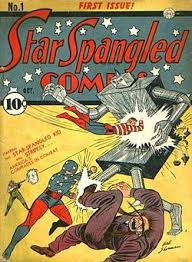
Golden-Age Goodness: Star-Spangled Comics #1

     October 1941 and the popularity of super-heroes in comics continues to rise.  Many of the most popular heroes had made their debut the previous two years, but there were several to still come:  Sargon the Sorcerer, Dr. Mid-Nite, Starman, Plastic Man, Phantom Lady, and Captain America have all been introduced earlier in the year.  DC Comics added a new title to their stable this month, the first new anthology since World's Best/World's Finest in April of that year, and unlike that title, this one contained new features.
     Star-Spangled Comics #1 was head-lined by the Star-Spangled Kid and Stripesy who were featured on the cover.  In the leaf story, the Star-Spangled Kid and Stripesy take down a group of saboteurs attacking American defense factories.  Neither the Star-Spangled Kid or Stripesy have powers.  The hook lies in it being an inverted Batman type strip with the kid being the main hero and the adult being the sidekick,  I was really stricken by how ahead of its time this felt.  The strip, by Jerry Seigel and Hal Morris, had a humor and light-heartedness that is missing from a lot of Siegel's other work around this time, and the art by Hal Morris looked like a cross between Dick Sprang and Jerry Robinson, especially with the exaggerated grin and chin that  is given to Stripesy.  Siegel does humor, but its typically more biting and cynical.
    The second strip was about an aviator, Captain X, who similar to Captain Desmo wears a super-hero style mask and colored costume, is an American reporter with a special plane, invisible and fast.  He stops a Nazi plot to dam the English Channel so their troops can cross.  I'll continue to read it if it continues on.  The art is a little loose and not very stylized. 
     After Captain X is an arachnid themed hero with the ability to climb walls and a weapon that can be used to swing around and ensnare criminals.  I'm not speaking of Peter Parker, but John Law, the Tarantula.  John Law is a crime author who with his special boots and web gun, captures gang boss, Ace Deuce.  It was a fun, fast-paced strip.  I only know of the Tarantula from All-Star Squadron.  Right now, he is very similar to the Sandman, who will later adopt a purple and yellow outfit very similar to the Tarantula.  It will be interesting to see how the strip adapts if it is still around at that time.  I skipped Armstrong of the Army, as I tend to only read the super-hero strips or those belonging to characters who made it into Who's Who.
    Finally, the book closes with a second Star-Spangled Kid strip, which is unusual for an anthology of this time.  Characters will appear in multiple titles, but unless they headline their own quarterly, not twice in the same issue.  In the this installment, they defeat a rampaging robot, the creation of Dr. Weerd, a Dr. Jekyll and Mr. Hyde-type mad scientist.  This was much like the first installment, light-hearted and breezy with large set pieces.  Here it is the robot.  All-in-all a good addition to the DC line-up.  The Star-Spangled Kid never stood out for me in the few appearances I've read from the 70's All Star Comics run, but here, in his natural environment, I can see the appeal.

Tuesday, January 26, 2016

Overlooked Gems of the Golden Age (circa 1940) - Part Two

The King
The King wasn't DC's first master of disguise (Cosmo, the Phantom of Disguise beat him by 4 years), but he is certainly the most interesting.  Created by Gardner Fox and William Fox, King Standish, aka The King was a master of disguise who when not impersonating someone was a opera cape and tuxedo-clad crimefighter.  His MO involved learning of a crime, waylaying or kidnapping someone involved with the enterprise and replacing them.  As far as I know, he never has revealed his real identity/face.  His most frequent foe is a femme fatale, the Witch.  It is the cat and mouse flirtation between the two that is the highlight of the series with her never realizing his presence until he reveals it.  The device of star-crossed adversaries isn't unique to this strip.  Espionage Agent X, Zatarra, the Spirit, and of course Batman have utilized it to varying degrees, but nowhere is the chemistry as strong as it is is between the King and the Witch, and it is the foundation of the strip.

Friday, January 8, 2016

Odds and Ends 1/8/2016

     For those who may have recently come to the blog, I hope you'll find that I try to be on the whole positive.  I don't write about everything I'm reading, but I like to mention or post highlights of either things that I think are significant from a continuity or history perspective, or things I really liked.  I tend to have three different reading lists:
 - Current comics.  I'm normally 2-3 months behind depending on the title and publisher.
 - Golden Age Read through: I'm currently in October of 1941 (I started with some from 1936), and I tend to group these by publisher within the month, so right now the focus is on DC.
- Marvel Silver Age Read through: I'm currently on December 1964.  I read everything except the Millie the Model and Patsy Walker type-stuff.  I'm not a snob against them, but it is basically Archie/Katy Keene comics in the Archie-house style.  When I finally got access to some, I had 3 years to read-through to catch up with where I was in my order with everything else, and ultimately, decided it wasn't worth it.


    The first book I want to briefly mention is Batman #7.  Two stories out of the four I thought were worth a mention.  In the first, the Joker returns from the dead (again), but he enlists and blackmails a group of practical jokers to work for him.  He gets them addicted to ever-increasing chaotic and dangerous pranks, until the city is in panic as the cover to his crimes.  I thought it was neat angle.  In the last story, Bruce Wayne is framed for a murder.  When put on trial, Batman appears (an escaped Wayne) to declare Wayne's innocence with no evidence.  The DA attacks the word of the vigilante, and Commissioner Gordon gives a stirring oration in the support of Batman.  Wayne is cleared with the real gunmen makes a deathbed confession, and Commissioner Gordon backs up his words by deputizing Batman and Robin.  If you were wondering when or how that came about, its this story.

    The issue that I've liked best out of my current backlog that I've read recently is Amazing Spider-Man #3.  Since it is of a more recent vintage, I'll try to be more spoiler-sensitive.  The story boils down to how the Human Torch reacts when he hears that his former home and headquarters, the Baxter Building, has been purchased by Parker Industries.  I like the heart shown in this issue, how Slott conveys the Johnny Storm/Peter Parker friendship, and how Peter treats his friends in general.  The only negative is while not everything has to be spelled out, I felt like there was tip-toeing by Slott on this issue because of what is and is not known about certain characters do the delay in the over-hyped, over-blown, mostly late Secret Wars event.

     Next, I'm going to make an exception to my always talk about the positive rule.  I try to read the letter pages if I can when I read comics, and in the November 1964 books, there have been a few praising Stan for his new humor mag, Monster to Laugh With.  Lies, and plants, folks, those letters are lies and plants.  I've read them (as Andy Leyland sometimes likes to say -- so you don't have to).  They are 36 pages of horror movies stills, of varying vintage, with one-liner word balloons.  The jokes are almost always a quote of an Ad slogan -- "Calmay, take me away!" or along the lines of "I have exaggerated feature (wrinkles, bandages, and fangs being the most common).  Don't I look funny?"  Nothing to elicit so much as a chuckle.  Nothing to see here folks.  Nothing to see....

    Finally, some reader feedback.  Kirk Groeneveld requested some pictures of Egghead's android from Tales to Astonish #61.  I've included two below one color, and one black and white.  I should clarify in case I mislead anyone.  When I called him a prototype Vision, I meant it from the perspective of it being a density changing android, not in terms of visual design.


Kirk Greenfield replied to the ending of my post on Strange Tales #127, that the original amulet of Dr. Strange was called 'Harold'.  If that were true, wouldn't the new one contain the Eye of Agga-Maude-O?  (And that's why I'm in IT and not a stand-up comic).


Monday, April 27, 2015

Convergence Blues

Convergence is so...meh.  Is anyone else as underwhelmed as I am?  I've only read Convergence #1, and a handful of crossovers (Atom, Batgirl, Batman and Robin, and Harley Quinn), bur its really disappointing:
1. Not only is the battle arena motif played out in popular culture right now, it went over like a lead balloon with Countdown Arena.  What may now the time to revisit it?
2. Not that misleading promotional buzz is anything new, but does anyone else feel a bait and switch?  This isn't revisiting old friends like they were.  The conditions under the domes have changed these characters.  They aren't as they were, and most of the titles haven't captured the flavor of the old runs. 
3.  I am an old school Captain Carrot fan.  It was my transition book.  I had a few super hero comics, but most of my earliest books were from Whitman grab bags.  Captain Carrot was the bridge from Bugs Bunny and Pink Panther to Brave and the Bold and Justice League for me.  Why do I think everyone is going to fall to pre-Flashpoint, New 52, or Nu Earth-2?  I want to see Captain Carrot and and Fastback as much as folks want to see the pre-Zero Hour Superman or the JLI.  I don't want them sacrificed in a heavy-handed metaphor on how their time is passed aka their heads handed to them by Harley Quinn or Prof. Zoom.

From start to finish the execution feels wrong.  How much cooler would it be if they were frozen in time, like flies in amber and they teamed-up against a mutual threat instead of squaring off in a ring.  And really pulling iconic representations, not every Elseworld also-ran.  You want to do a story of the Atom?  Either follow-up on where the back-ups were taking him pre-Flashpoint (which seemed like a cool back-to-basics approach) or Sword of the Atom era Atom.  I give DC a lot of slack.  Yes, the Superman books have been so-so since the new 52, but there has been a lot of good to come out of it (All-Star Western by Gray and Palmotti, Batman by Snyder and Capullo, Wonder Woman by Azzarello and Chiang, Batgirl by Cameron Stewart as examples). I'm just not used to an "event" from DC leaving me feeling this way.

Wednesday, April 22, 2015

More Weirdness from the Golden Age (circa 1940)

How do you challenge Hawkman, the Winged Wonder?  Have him faced with an invasion from an underwater race, the Kogats.  How do you have him overcome the challenge?  With a literal deus ex machina courtesy of Flash Comics #9 -- Poseidon grants Hawkman the ability to speak and breathe underwater!!!  Wonder if we'll ever see that ability used again?

Monday, April 13, 2015

Overlooked Gems of the Golden Age (circa 1940) - Part One

Red, White, and Blue
Debuting in All-American Comics #1, the feature told the adventures of Red Dugan, Whitey Smith, and Blooey Blue childhood friends who had enrolled in the Aire Force, Army, and Navy respectively.  The three are hand-picked by Army Intelligence to undertake special missions at home or abroad.  The fourth member of their group was FBI agent Doris West who was their handler and typically already undercover and thoroughly mixed up in whatever the team was asked to investigate.  The strips have good clean art from William Smith (better than a lot of the 1939/1940 art) and a setup that served a wide variety of stories from Jerry Seigel in one of his earliest non-Shuster collaborations.  The majority of the adventure/war/detective strips seem limited in their plot repertoire, but Red, White, and Blue plots range from confronting saboteurs and fifth columnists to racing foreign powers to lay claim to a natural resource.  There is a formula: Doris normally gets in over her head, Blooey normally bungles his way into and out of trouble, with Whitey and Red bringing in the cavalry.  The antics of Whitey and Blooey provide comic relief without veering into full-on slapstick and the attraction between Doris and Red gives Seigel the opportunity to write a lot of romantic comedy banter in the nature of Myrna Loy and William Powell.

Wednesday, April 8, 2015

Weird Facts from the Golden Age (circa 1940)

- Hawkman's Nth Metal wings and belt were originally Ninth metal in Flash Comics #1
- Villain watch:  Super Villains that have popped up in reading: Dr. Death, Hugo Strange, Clayface I, Joker, Catwoman, Ultra-Humanite, Lex Luthor, Wotan (Dr. Fate villain), Nyla (Hawkman villain), Zor (Spectre villain) and Kulak (Spectre villain).  Most of these won't be seen outside of the the Golden Age until appearing in All-Star Squadron.
- All-American gave out free copies of All-Star comics #2 for feedback on All-Star #1 and repeated the give-away for All-Star #3.  Can you imagine getting for free All-Star Comics #3 ?!?!
- I've just started listening to Tales of the Justice Society podcast by Scott Gardner and Michael Bailey.  Mike has no love for Johnny Thunder.  According to the front cover of All-Star Comics #2, he was added to the title's content because of reader requests.
- Love interests don't play the part you necessarily expect them to.  Superman has Lois Lane, thought the relationship is one-sided and at the "What a man!" level of sophistication.  But while Joan Williams and Shiera Saunders have been in 4 out of the 7 issues of Flash comics, they aren't yet Girl Friday's.  Normally they meet in passing or the start of the story is the end of a date.  Only Dian Belmont actively participates in Sandman's adventures.
- And speaking of Sandman, maybe Dr. Mid-Nite isn't the only doctor in the JSA:
    From Adventure Comics #54 (reprinted in Golden Age Sandman Archives), "It's a good thing I crammed in those two years of medical school"!

Wednesday, October 23, 2013

Action!!!--Action Comics #1, June, 1938

    So time for the change-up.  As promised (hopefully) some what more concise reviews.  While it is easier for me to read a block of Golden Age comics in a row, for you dear readers, I'll continue to post no more than 3 issues in a post.  This one merits its own.
    4 months and 75 years ago, Action Comics #1 was published.  While it wasn't the issue that started the comic-book industry, it is commonly accepted as the first appearance of what we now consider to be a super-hero, and the issue that served as the cornerstone for the industry we know today.  In Action Comics #1, Superman made his first appearance.


Superman - 'Superman, Champion of the Oppressed'  by Jerry Siegel and Joe Shuster
     Superman breaks into the governor's mansion to secure a pardon for an innocent woman, gives a wife beater a taste of his own medicine, saves Lois Lane from a kidnapping, and dangles a lobbyist from some power cables to find out which crooked senator with whom he is dealing.  This first chapter moves at a break-neck speed.  Most of the classic trappings are in place: Clark Kent reporter, Lois Lane, and the basics of his origin.  Superman is instantly likeable, Siegel basically writes Superman as Slam Bradley with super powers. Rating: 4.5

Chuck Dawson - 'The A-G Gang' by Homer Fleming
    A western strip about a cowboy who rides into town looking to get revenge on the gang that killed his father.  Chuck ends up the wrong side of the law when he escapes from prison after coming out on the losing end of the fight.  A bland strip that doesn't make a lot of sense.  The main character has such a large chip on his shoulder he rides into town believing everyone must be part of the gang.  He goes out of his way to pick fights with every one he meets.  Rating: 2.5

Zatara - 'The Mystery of the Freight Train Robberies' by Fred Guardineer
     Zatara and Tong investigate and break of the Tigress' train robbery ring.  Even if Superman hadn't of been introduced, Action Comics would have been worth noting because of the Zatara strip.  It's quick paced and fun.  There's good chemistry with Zatara and Tong, and it was fun to see the backwards spell his daughter Zatana would be known for being used. Rating: 4

Pep Morgan - 'The Light Heavyweight Championship' by Fred Guardineer
    Pep is a sports strip about an extremely athletic college student that has bounced around the DC titles.  In this strip, he fends off a crooked promoter who has his champion try to drug Pep during the fight.  Not a bad strip, but in the early days anything was fodder for a strip, so all genres were acceptable.  While they can make for an interesting diversion, the limited story potential prevents real character development.  Still it has serviceable art for the period.  Rating: 3

Scoop Scanlon, Five-Star Reporter - 'The International Jewel Thief'' by John William Ely
    A crusading reporter follows a scoop about an international jewel thief coming to town and aids the police in his capture.  The highlight of the strip is the chemistry between Scoop and Rusty, his photographer.  I also like that it shows some down time as they wait for thief's ship to come in.  Unfortunately its let down by some pretty crude art. Rating: 3

Tex Thompson - 'Murder in England' by Bernard Bailey
    Traveling wealthy Texas oil man, finds a body in the English countryside and is framed for the murder.  A decent enough  adventure/crime strip with decent art. Rating: 3

Overall rating: 4


Monday, October 21, 2013

New Adventure Comics #26

(Editor's Note -- Rather than try to put this in the new format I'll be using going forward, I decided to preserve this one in its original format since I started it 4 months ago.)
     I still haven't found the right mix of insight and brevity.  I feel compelled to provide a 'Story so far...' synopsis to every feature.  Here is what I am going to attempt.  I'll list every feature with a 1-2 sentence synopsis and make comments about those that I feel merit additional discussion.  I still feel the need to mention every issue so readers of the blog can get a sense of the chaotic ebb and flow of the Golden Age.  So without further adieu, New Adventure Comics #26:


Captain Jim of the Texas Rangers -- "The Train Robbery, Part 26"
     One of the few strips that's been in every issue of New Adventure (originally New Comics), this is the adventures of an older rancher, his niece and nephew, his best friend, the Captain Jim in the title, and his trusted ranch foreman who are in never-ending trouble with bears, stampedes, rustlers, bank robbers, etc.  It would be exhausting to read in a collection, but it works well in serial parts.  The only problem is the expanse of characters.  The strip gets a good number for this day and age (approx. 6), but by the time you catch up with all the leads who are in at least three different places, the story doesn't advance any more than a 3-pager.

Federal Men -- "The Safety Patrol"
     I find Federal Men to be the oddest of the Seigel and Shuster strips.  Ostensibly, the lead is Steve Carson, an FBI Agent.  Initially the strips were him in gang buster or pseudo Sci-Fi stories toppling gangs, saboteurs, or mad scientists.  Soon there were adds for 'Junior Federal Men' club membership packs, and the strip changed from being about the exploits of Steve Carson to being about kids who become crime-stoppers and good citizens as a result of their emulating Steve and being in the club.  In this strip, Steve is only seen in the beginning talking about road safety to the school, then shifts to how the kids implement his lecture and deal with a hit-and-run driver, then ends with Steve delivering the motto.  Its not bad at all, because it has the Siegel and Shuster energy that was unique to their strips at the time, but I felt it worth noting how the strip had changed, and I'm curious if boy interest in the strip was really that high or if it was a marketing stunt/wishful thinking.

Nadir, Master of Magic  --  "Pearl of the Bleeding Heart, Part 10"
     An adventurer/magician tracks a stolen, cursed pearl.  Not a bad strip, but after the first 3 installments, the magic has all but disappeared (literally) and  Nadir is indistinguishable from other socialite/adventurers.  The pearl however, is seriously cursed.  It now in its third or fourth owner, all of the previous owners being killed and betrayed by the owner after them.

Rusty and His Pals -- "The Pirate Ship, Part 1"
     A group of kids build a raft, play pirates, and run into real pirates.  Notable for being one of the first contributions of Bob Kane to DC Comics and the first of two in this issue.  I won't get into the quagmire (right now) of to what extent Bob Kane was a "real" creative professional, but I think it important to note the milestone considering the contribution he will make in another year.

Don Coyote
    Don Coyote is a humor set in medieval times, but utilizing modern slang and sexual attitudes (well, modern from the perspective of 1938).

Dale Daring -- "The Red Hatchet, Part 4"
    Being named after the female lead, you'd almost expect this to be about a female adventurer Ala Sandra of the Secret Service, but Dale Daring owes more to 'The Perils of Pauline'.  A blonde heiress and her father somewhere in Asia (maybe Tibet) fall afoul of a Mongol tribe with Capt. Don Brewster hurrying to the rescue.  Not very memorable.  In fact, I struggle to remember what was the macguffin or crime that started the whole strip.

Captain Desmo --"Captain Demso Flies Again!"
    A heroic fighter pilot defends an outpost against Mongol raiders. Notable for Captain Desmo's laughable pseudo-super hero stryle outfit.  Considering what was to be published in June, 1938, something was in the air.

Click Evans -- "In the War Zone"
    A newsreel reporter crashes in a war zone, is taken prisoner, and escapes.

Cal n' Alec
    A humor strip about two cowhands who get into mischief.  In this installment, their donkey is stolen by an Indian (nee Native American), and the two try to steal it back.

(Editor's Note --My thoughts for here on out are now 4 months old.  I apologize if I have nothing profound to say...not that I've been profound up to this point.)
Detective Sergeant Carey of the Chinatown Squad
    Sgt. Carey and Sleepy  try to escape the Tong by boat.  Fairly typical 'yellow menace' fare.  The main advantage to the Sgt. Carey serials is they are kept to a respectable 3-4 parts and not 9-10.

Sandor and the Lost Civilization
    Ostensibly a jungle strip, Sandor takes place in and entails intrigue in the court of an Indian rajah.  Unfortunately, I've lost the thread of the plot.  Its been the same serial since the beginning.  Now its devolved to random running around the palace.

The Golden Dragon
    A group of adventurers searching for Genghis Khan's gold route the Mongolian army trying to stop them.  Like Sandor and Captain Jim, The Golden Dragon has been in almost every issue of New Adventure.  I like the serial overall.  Its moving at a slow pace (they've barely made any progress), but unlike Sandor, I can still keep up with the plot.


Friday, October 18, 2013

Battle of the Atom, Forever Evil, and Infinity

So, there are currently three events running concurrently in DC/Marvel: Battle of the Atom, an X-Men crossover, Forever Evil a DC line-wide crossover, and Infinity, an Avengers crossover.  I'm relatively current with these, so I'll be presenting my thoughts to-date.  Of course here be spoilers, arrgh!!!


S
P
O
I
L
E
R
S


Battle of the Atom
    Spinning out of All-New X-Men, the synopsis for Battle of the Atom is fairly straightforward: armed with the hindsight of what their continued presence in the present of the Marvel Universe means, a team of X-Men from the future come to the present to coerce/force the original 5 X-Men to return to their time of 1960's Marvel  (okay, okay, whatever passes in Marvel continuity for what was originally the 60's when the early X-Men comics were originally published).  With two Battle of the X-Men bookends, the story runs through All-New X-Men, Uncanny X-Men, and X-Men.  I believe it is 18 parts in all, and it is somewhere around part 9.

While not as "epic" as the other two events, this is currently my favorite.  I've posted a large post here about my love of All-New X-Men, and I feel like with this event, I'm getting a new installment every week.  If you aren't reading All-New X-Men, start right now, and get this in the trades at the very least.  A very strong 4.5 out of 5 for me.


Forever Evil
    Continuing in a lot of ways continuing from Trinity War which was not an event so much as a preamble, Forever Evil chronicles the defeat of the Justice League by the Crime Syndicate of Earth-3 (Pandora's box was a portal to Earth-3) and the rise of the villains who stand in their way.
    While this did have a long preamble, in many ways I have a hard time judging this event yet.  It is a 10 part series with at least 3 6-issue mini-series crossovers.  So far only issues 1-2 and the first issue of Arkham War have come out.  So far, I give it a 3.5 out of 5 with it showing a lot of potential.  While I knew I was right about the Outsider being the head of the Secret Society, it was a clever twist and a wink to the silver age to have him be the Earth-3 evil Alfred, and hearing Luthor saddle up while secretly pining for a Superman to save the day is comics-gold.
    The cost of this is a worry point if you want to follow the tie-ins because you're talking about 30+ issues, but the tie-ins sound so damn intriguing.  The Rogues from Flash refusing to follow the Secret Society's orders and destroy Central City, but rather stand to protect it because of one of their own being in a Central City hospital in Forever Evil: Rogue's Rebellion.  Or Bane trying to conquer a Gotham City that's been divided into fiefdoms by the escapees from Arkham in Forever Evil: Arkham War.  Those two at least, I think I'm going to have to get.


    Infinity is a 6 part mini-series that crosses over with Avengers Assemble, New Avengers, Avengers, Mighty Avengers, and Thunderbolts, with New Avengers and Avengers being the most important to following the through-line with Infinity.  Infinity reminds me a lot of Infinite Crisis in that Infinite Crisis was the culmination of several bad things happening at once.  In Infinity, the majority of the Avengers are in space fighting the builder's armada which is intent on razing Earth and the Illuminati are distracted by both incursions from alternate earth's destroying planets as well as the infighting between Black Panther and Namor.  Thanos picks this moment when most of the heroes are away to invade Earth as a cover for searching for and killing his heretofore unknown about son, Thane.
    Infinity, just the 4 issues do-date on its own gets a 4 out of 5 for me.  There's a lot happening at a brisk pace with some big ideas.  I was worried about the rumors of everyone becoming an Inhuman coming out of this, but I like that the Terrigen bomb only effected those who are partially Inhuman in their ancestry.  It's the build-up and ancillary series that are let down.  Avenger in particular, which has been building to this cross-over for some 15 or so issues has been horrible, so I have include that preamble and the tie-ins, it would fall to a 3 out of 5 (most of the Avengers issues have been around a 2 or 2.5 out of 5 for me since Hickman took over).